How Feminism relates to us, in the western world
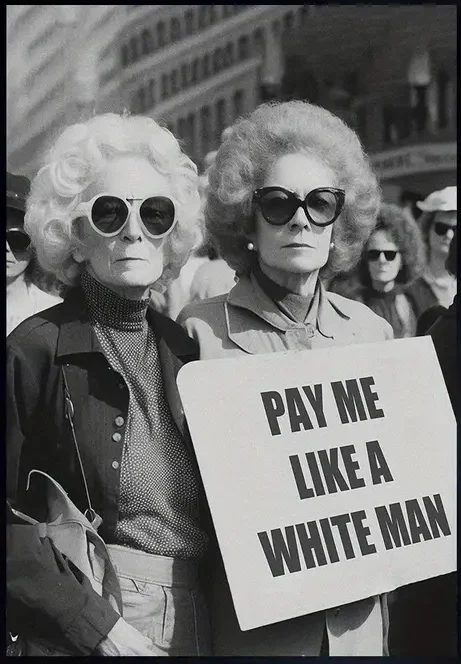
Everyone in this world needs to work to make a living, men and women. Nonetheless, a woman in Germany in 2019 earned on average 21 per cent less wage per hour than a male, which is 17 euros less, sometimes even for doing the same job. That relates also to the issue that women occupy more jobs in fields that are not paid much in general, which includes medical and social care.
However, this stereotypical job choice is linked to how we still raise many children. Girls are still taught that they should be gentle and play with dolls instead of in the mud. Whereas boys are portrayed as strong superheroes and handymen. I am not saying this is the case in every household, but stereotypical media, toys and clothing do impact the work choices of children and the tasks they feel capable of. How children or young people link gender to specific roles is also because of our language. That is especially an issue in languages which gender such as German, Italian and French. In German, a cleaner is called Putzfrau or in English cleaning lady. But there is no alternative in German, there is no “cleaning-man”, Putzmann. A nurse is called Krankenschwester, meaning a sister to the sick. That is the official occupational title. People are just about to adopt the idea of a stay-at-home dad, “Hausmann” and women are still judged if they leave their children in daycare and go to work. Changes in language and adopting gendered language is a slow process but it does demand active self-reflection, meaning awareness of the way we talk and acknowledgement that the problem exists, that we unconsciously assume that a nurse is female in German.
This leads to a woman’s role in her workspace, particularly in men-dominated fields. There are studies including Gender and Discourse by Sage Publications, which state that women generally speak less in their workspace, especially in meetings. The reason for that isn’t as one could propose that the women had fewer ideas, but it seemed to be that men just once they began talking spoke for a significantly longer time and repeated ideas by women over and over so that in the end other participants of the meeting thought the idea was contributed by the man who only repeating it. This is just one of the factors why women must prove themselves harder to be rewarded or even be employed. According to data by the Ministry of Education in the UK from 2018, men doing apprenticeships in all kinds of jobs earn on average £1,000 a year more than women who were educated at university and Women with degrees are more likely to be out of work than men with no qualifications. The pay gap likewise evolves from the issue that women are not presented in upper management and hence not represented in decisions making. Why men are chosen for these jobs can have multiple reasons, one is that women are accused of wanting to have children and go on maternity leave. For this reason, they are underrepresented in decision-making. A very well-known example of this phenomenon is the science sector. Women are more likely to die in case of a car accident, not because they cannot drive but because no women were involved in testing and developing the crash dummy and hence the dummies had male properties.
Payment and power are two major aspects which highlight the inequalities a woman has to deal with but sexual harassment is often a workplace-related problem too. In 2017 Harvard University published a report on the topic of How Adults Can Promote Young People’s Healthy Relationships and Prevent Misogyny and Sexual Harassment. This survey of 18 to 25-year-olds indicates that “almost 60% of respondents—66% of males and 51% of females—would not say anything if they overheard a male friend say about a woman, “I’d hit that.” And terrifying “87% of women in our survey of 18 to 25-year-olds report at some point in their past having endured being catcalled (55%) or insulted with sexualized words (e.g., slut, bitch, ho) by men.” This current survey represents the young western generation, which illustrates that it is a present issue in our generation.
These are just a few examples of inequality and unfair and limiting treatment of women. Women need more representation and a say in their workspace. The debate is not about men losing something but about equalling everyone’s possibilities and how everyone is treated. The aim is to open doors for everyone, a man should be able to stay at home without being judged and women should earn enough to be just as much able to feed the family as the man would and she should do so without being judged for “leaving the children”. And if she doesn’t want any kids that should be accepted too, as it is for men.
Disclaimer: Einige dieser Texte sind noch aus meiner Schulzeit. Sie zeigen also nicht unbedingt, wie ich heute denke, schreibe oder mich ausdrücke.
How Adults Can Promote Young People’s Healthy Relationships and Prevent Misogyny and Sexual Harassment, Harvard Report 2017
Stand: 14.09.2020
Stand: 14.09.2020